
The 50 High Points Record
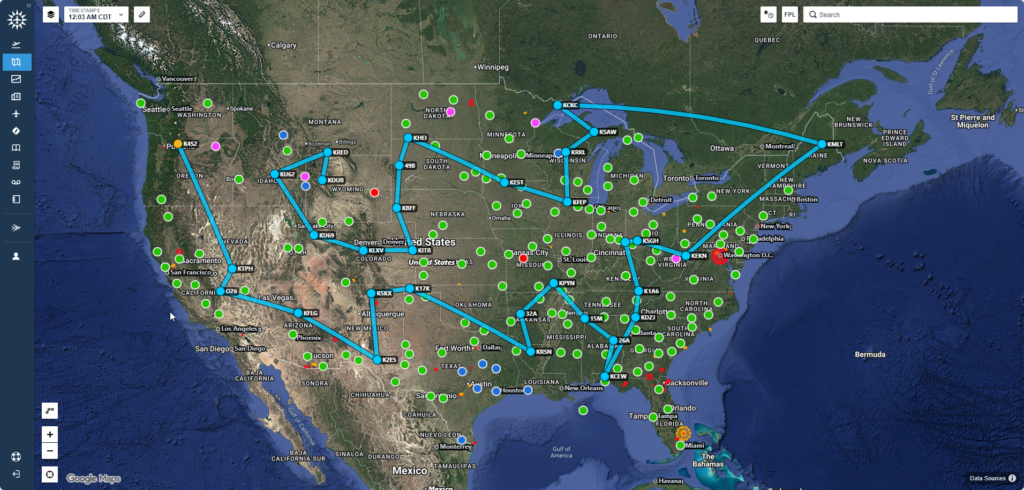
This summer (June 2026), Branndon from The Highpointers is gearing up for a shot at one of the wildest adventure records in the United States: touching the highest point in all 50 states faster than anyone has ever done it before. And this time, the aviation community has a chance to be part of the story, not just watch it unfold from the ground.
The record Branndon is chasing
In 2018, endurance athlete Colin O’Brady set what’s widely recognized in the mountain and FKT world as the benchmark for this challenge: summiting all 50 U.S. state highpoints in 21 days, 9 hours, and 48 minutes. His effort covered roughly 13,000 miles of travel and more than 300 miles of hiking and climbing, from Denali in Alaska to Mauna Kea in Hawaii and every state highpoint in between.
Guinness currently lists a separate “fastest time to climb the highest points in all 50 US states” at 30 days, 15 hours, and 50 minutes, set in 2024 by Matheson Brown, which reflects their specific verification rules rather than the pure fastest-known-time style record O’Brady holds. For highpointers and FKT followers, the time to beat for a “pure speed” push is that 21 days, 9 hours, 48 minutes mark.
Who is Branndon, and why he’s built for this
Branndon is one half of The Highpointers with the Bargo Brothers, an adventure duo already known for blending human-powered suffering with big, imaginative objectives. He and his brother Greg were the first to climb Denali, the highest point in North America, and then bike 4,000 miles self-supported all the way to Baja, Mexico—a project that shows exactly how comfortable they are living on the edge of what seems reasonable.
That history matters, because a 50-state highpoints record attempt isn’t just about fitness; it’s about logistics, sleep deprivation, decision-making, and keeping your stoke high when your body is saying “enough.” Branndon comes into this challenge with deep highpointing experience, a proven appetite for Type II fun, and a community already built around sharing these stories with the wider world.
The route: from Denali to the plains
For this attempt, the clock will start in Alaska and stop in Wyoming, following a deliberate path that balances big mountains, travel constraints, and weather windows. Branndon’s planned sequence is:
Alaska → Hawaii → Washington → Oregon → Nevada → California → Arizona → Texas → New Mexico → Oklahoma → Louisiana → Arkansas → Missouri → Mississippi → Alabama → Florida → Georgia → South Carolina → Tennessee → North Carolina → Virginia → Kentucky → Indiana → Ohio → West Virginia → Maryland → Pennsylvania → Delaware → New Jersey → Rhode Island → Connecticut → Massachusetts → New York → Vermont → New Hampshire → Maine → Minnesota → Michigan → Wisconsin → Illinois → Iowa → North Dakota → South Dakota → Nebraska → Kansas → Colorado → Utah → Idaho → Montana → Wyoming
This path knocks out the two huge logistical outliers—Alaska and Hawaii—up front, then slingshots into the Pacific Northwest and arcs across the West before dropping into the South and sweeping up through the Midwest and Northeast. It ends in the Rockies with Colorado, Utah, Idaho, Montana, and finally Wyoming, where Branndon will tag the last summit and stop the clock.
Here’s a quick look at the flavor of what he’s stringing together:
Serious alpine objectives like Denali (AK) and the big Western peaks.
Long but manageable hikes such as Texas, Colorado, and many of the New England summits.
Road-access or near-road highpoints like Florida’s Britton Hill or Delaware’s Ebright Azimuth that still require tight navigation and timing when you’re exhausted.
Individually, many of these highpoints are approachable. Stacked back-to-back with almost no down time, they become a single, continuous endurance test.
Why aviation is the secret weapon
For O’Brady’s record, road vehicles did the heavy lifting on the 13,000-mile linkup between summits. Branndon’s team wants to lean into something different: making aviation a core part of the project’s DNA and logistics.
This is where pilots, aircraft owners, and the broader aviation community come in. The attempt naturally lines up with multiple aviation strengths:
Point‑to‑point efficiency
GA aircraft can cut hours of driving between certain clusters of states and unlock smaller airports closer to trailheads.
Flexibility with weather and routing
Multiple pilots and aircraft mean you can adjust in real time around systems and still keep Branndon moving toward the next peak.
Storytelling from the sky
Aerial approaches to classic highpoints—like the Rockies, the Cascades, and the Appalachians—make for the kind of footage and perspective that turns an impressive record attempt into a truly cinematic one.
If you fly a capable single or light twin, operate a charter, run a flight school, or manage a corporate flight department, this is a rare opportunity to make your aircraft part of an adventure that will resonate across both the mountain and aviation worlds.
How pilots and partners can help
To pull off 50 highpoints in under 21 days, every transition has to be ruthlessly efficient. That means overlapping driving, flying, crew swaps, food, sleep, and gear transitions so that Branndon spends as many minutes as possible moving uphill, not sitting still in a parking lot.
Here are specific ways the aviation community can plug in:
Pilots and aircraft
Volunteer as a segment pilot for one or more regional hops (for example, Pacific Northwest, Southwest, Deep South, Midwest, or Northeast).
Offer aircraft time—singles, twins, turboprops, or even helicopters where appropriate—to shorten key legs.
Airports and FBOs
Provide courtesy cars, fuel discounts, hangar space, and fast-turn support for an on-the-clock team.
Help coordinate local media to amplify the story and draw in community support.
Sponsors and brands
Aviation companies—avionics manufacturers, headset brands, flight schools, charter operators—can help with funding, logistics, or gear and, in return, become part of the narrative woven through daily content.
Content creators
Pilots and creators can fly chase, capture air‑to‑air and en‑route footage, and help push the story out in near real time to aviation and outdoor audiences.
Logistically, think of this project as a relay: aircraft, pilots, and crews handing Branndon off from region to region as he runs the continuous thread of summits.
Why this story matters
Highpointing already attracts a certain type of person: curious, persistent, and willing to go far out of their way for a view and a benchmark. Layer a 50‑state speed record on top, and it becomes a story about how far you can push human endurance and logistics when community shows up around a shared goal.
Bringing aviation into the heart of this attempt does more than shave hours; it connects two passionate communities that don’t always overlap: the climbers looking up at the sky and the pilots looking down at the ridgelines. The result is a project that can inspire new highpointers, new pilots, and a new generation of people who see the United States not just as a map of states, but as a linked chain of summits and small airports waiting to be connected.
If you’re a pilot, aircraft owner, FBO, or aviation brand and want to help get Branndon to the next highpoint faster, what part of the country do you most want to support—West, South, Midwest, or Northeast?